
Nadi astrology: complete guide is a practical introduction to a tradition-based form of astrological or divinatory consultation often associated with readings attributed to palm-leaf records, sometimes called Nadi leaves. People may explore it for reflection on relationships, work, family, timing, spiritual questions, or other life concerns.
Descriptions of Nadi astrology vary considerably. A practitioner may describe a process of matching a seeker to a leaf or record, interpreting topic-based passages, and discussing possible life themes or future periods. Other providers may use different terminology, methods, languages, or delivery formats. This guide explains the framework commonly associated with Nadi readings while separating traditional descriptions from claims a prospective client can independently assess.
This is not a guide to guaranteed outcomes. Whether you are simply curious or considering a consultation, a useful approach is to combine openness with clear questions, careful privacy choices, and personal control over important decisions.
Nadi Astrology at a Glance
- Central idea: Nadi astrology is often described as a consultation tradition centered on palm-leaf records and their interpretation.
- Role of the reader: The experience may depend substantially on the practitioner’s matching method, language skills, translation, interpretation, and discussion with the seeker.
- Common topics: Seekers may ask about relationships, family, career, finances, wellbeing, timing, purpose, or spiritual practices.
- What can vary: Requested information, the matching process, reading length, fees, follow-up arrangements, and whether notes or a recording are supplied can differ by provider.
- Important distinction: A tradition’s account of its leaves, methods, or predictions is not the same as independently verified evidence of accuracy for an individual reading.
A consultation may still feel meaningful as a spiritual or reflective experience. Meaning, however, is different from proof that every statement is accurate, that a future event must happen, or that you should make an immediate major decision.
The Traditional Framework Behind Nadi Readings
People researching Nadi astrology are likely to encounter several recurring concepts. The wording used, and the importance attached to each concept, can differ among practitioners.
- Nadi leaves: Palm-leaf records said within the tradition to contain material relevant to particular seekers or life topics.
- Identification or matching: A process through which a practitioner may attempt to identify a leaf or record believed to correspond to the person seeking a reading.
- Chapters or topic sections: A reading may be organized around separate areas of life rather than delivered as one undifferentiated account.
- Interpretation: The reader may translate, explain, contextualize, or discuss the material. This human element can shape what the seeker hears and how it is understood.
- Predictions and timing: Practitioners may offer statements about possible developments, periods, or themes. Treat these as interpretations or claims, not certainties.
- Suggested practices: Some consultations may include spiritual, devotional, or lifestyle-oriented recommendations. These should remain voluntary and should never be used to create fear or pressure.
Because practices vary, it is reasonable to ask a provider to explain their specific method in plain language before you book. A clear explanation is more useful than a vague assurance that a reading will reveal everything.
What Are Nadi Leaves?
In descriptions of Nadi astrology, Nadi leaves are represented as palm-leaf records used in certain styles of consultation. The traditional framing may hold that a leaf can be connected with a particular seeker and contain material about that person’s life. In an individual session, the more directly assessable details are what information was collected, what was read or translated, what questions were asked, and what terms the provider offered.
Several steps may sit between a physical record and the final consultation experience. These can include preservation, transcription, language, translation, the practitioner’s interpretation, and the way a statement is explained in conversation. Those factors do not automatically invalidate a reading, but they are reasons not to treat a polished or specific-sounding statement as unquestionable fact.
If a provider refers to a particular leaf, ask how the text will be presented during the consultation, whether you will receive a recording or notes, and which parts of the session are presented as direct reading versus interpretation.
How a Nadi Astrology Reading Is Commonly Described
Not every provider follows the same sequence, but a Nadi reading is often described through stages like these:
- Initial inquiry: You contact a practitioner or service, ask about availability, pricing, language, and format, and decide whether the service suits you.
- Information collection: The provider may request personal details before the session. The information requested and the reason for requesting it should be explained clearly.
- Possible matching or identification: The practitioner may undertake a process intended to identify a relevant leaf or record. This stage may involve questions, statements, or confirmations.
- Reading and interpretation: The practitioner may read, translate, summarize, or interpret material connected to particular topics.
- Question-and-answer discussion: You may be invited to ask about work, relationships, family, or timing. It can help to distinguish what the reader stated before your answer from what was discussed after you provided context.
- Notes, recording, or follow-up: Some services may offer a recording, transcript, summary, or later consultation. Confirm this in advance rather than assuming it is included.
Before sharing anything sensitive, ask what information is necessary, whether it is optional, who can access it, and how long it will be kept. You can pause or decline if the answers are unclear.
The Identification or Matching Stage: Questions to Ask
The matching stage is often the part of Nadi astrology that creates the most curiosity. It can also be the point at which a seeker shares the most information. Understanding the process beforehand helps you decide what you are comfortable disclosing.
- What information do you need before the reading, and why do you need it?
- Are the requested details optional, or can I decline some of them?
- During matching, will you make statements before asking me questions?
- How do you distinguish a potential match from a non-match?
- What happens if no match is found?
- Is matching or searching billed separately from the reading itself?
- Will my answers guide later interpretation, and how will that be explained?
- Can I stop the process if I am uncomfortable with the questions being asked?
You do not have to treat a request for personal information as routine simply because it is presented as part of a spiritual process. You may ask for an explanation, limit what you disclose, postpone a decision, or choose not to continue.
What Can a Nadi Reading Cover?
A Nadi consultation may be presented as addressing many areas of life. These are best understood as possible discussion topics, not promised outcomes:
- relationships, marriage, or partnership concerns;
- family dynamics and responsibilities;
- education, work, career direction, or business decisions;
- money concerns and general financial-planning themes;
- personal transitions, timing questions, and future hopes;
- wellbeing, emotional concerns, or stress-related reflections;
- spiritual interests, values, and personal practices.
A reading is not a replacement for qualified medical, mental-health, legal, financial, safety, or emergency guidance. Do not rely on a prediction to diagnose a condition, decide whether to seek care, sign a contract, invest money, end a relationship, or manage a crisis. For consequential decisions, use appropriate professional advice and your own informed judgment.
Nadi Astrology vs. Birth-Chart Astrology
| Area | Nadi astrology, as commonly described | Conventional birth-chart consultation, broadly described |
|---|---|---|
| Primary framing | Often associated with palm-leaf records, matching, and topic-based readings. | Often centered on an astrological chart calculated from birth information. |
| Typical inputs | May involve information requested for identification or matching; methods vary. | Typically uses date, time, and place of birth, though practices vary. |
| Consultation format | May include a matching stage, reading, translation, and discussion. | Usually involves chart interpretation and discussion of placements, periods, or themes. |
| Key practical question | How does the provider conduct matching and handle personal information? | How does the practitioner calculate and interpret the chart? |
| Accuracy claims | Neither format should be assumed accurate simply because it is detailed, traditional, or confidently presented. Interpretation and practitioner method matter, and claims should be assessed carefully. | |
This comparison is about process, not a ranking. Different people may value different formats for personal or spiritual reasons. In either case, transparency and informed consent are more useful signs of a responsible service than dramatic promises.
What to Expect—and What Not to Expect
A Nadi reading may include broad themes, specific statements, tentative language, follow-up questions, or different levels of detail depending on the provider. You may find parts resonant and other parts unclear, irrelevant, or uncomfortable. It is reasonable to ask for clarification, take notes, and give yourself time to reflect.
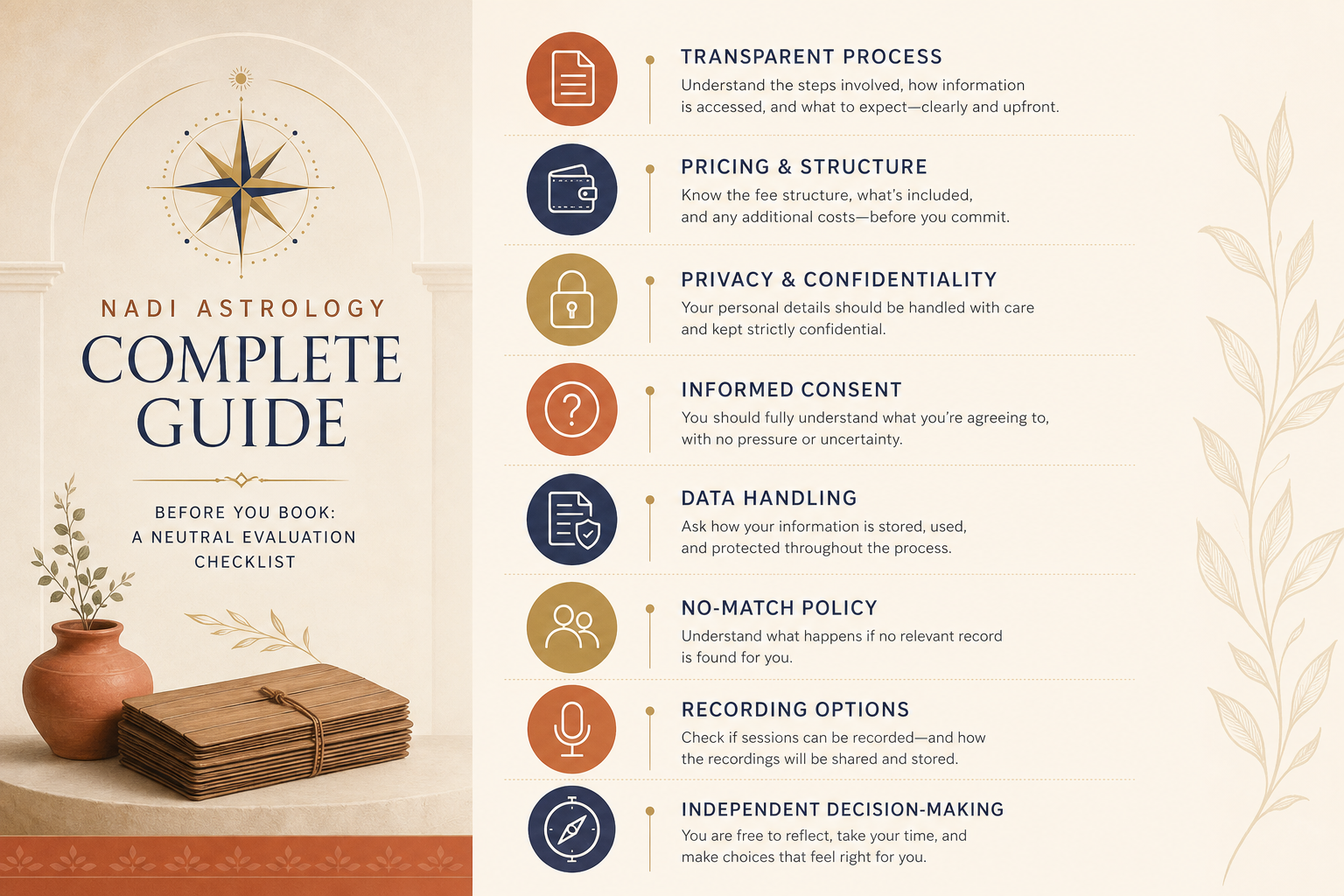
Specificity alone does not establish accuracy. A statement can sound highly personal while still requiring interpretation, relying on information shared during the conversation, or fitting more than one situation. Be especially cautious if a provider uses fear, urgency, absolute certainty, or warnings of harm to encourage immediate decisions or additional purchases.
You retain the right to pause, decline recommendations, seek another perspective, or end a session.
How to Evaluate a Nadi Astrology Provider
Before booking, look for practical transparency rather than promises that are impossible to assess in advance. A provider or digital service should be willing to explain what is included and what happens if the session does not proceed as expected.
Questions about process and scope
- What does the session include, from initial matching through the final discussion?
- How long is the appointment expected to last?
- What language will be used, and is translation involved?
- Will I receive a recording, transcript, written summary, or follow-up option?
- What are the boundaries of the service? Does the provider avoid presenting the reading as medical, legal, financial, or mental-health advice?
Questions about fees and policies
- What is the total cost, including any matching, translation, chapter, recording, follow-up, or recommended-practice fees?
- Is there a no-match policy, cancellation policy, refund policy, or rescheduling policy?
- Are additional services optional, and can I decide later without losing access to the main session?
Questions about reputation and communication
- Is there a clear way to contact the provider before payment?
- Are terms, policies, and communication channels easy to understand?
- Do independent reviews describe the process and service experience in detail, rather than only making broad claims?
Testimonials and reviews are personal accounts. They may help you understand customer service, scheduling, or delivery, but they are not independent proof of predictive accuracy.
Privacy and Digital Access: A Pre-Booking Checklist
Online access can be convenient, but it also makes data handling an essential part of your decision. Review this checklist before you share personal details or make a payment:
- Consent: Will the provider record audio or video? Ask for consent terms before the session begins.
- Requested data: Are you being asked for your name, birth details, photograph, fingerprint, identity document, contact details, or other sensitive information? Ask why each item is needed.
- Data retention: Where will your information, recordings, and messages be stored? How long will they be retained, and can you request deletion?
- Access: Who can see or use your information: the reader, translator, staff, technology provider, or another party?
- Payment: Is the payment method clear and secure, and do you receive a record of the transaction?
- Account security: If you create an account, use a unique password and avoid sending sensitive data through channels you do not trust.
- Your copy: Will you receive a transcript, notes, or recording, and are there stated conditions for accessing it?
Do not disclose more personal information than you are comfortable sharing. If a request feels unclear or excessive, pause and ask for a written explanation.
How to Respond to Predictions and Recommended Practices
Predictions can feel emotionally significant, especially when they relate to relationships, health, finances, family, or loss. A grounded response is to separate reflection from action.
- Write down what was said as accurately as possible, including the context and any uncertainty expressed.
- Give yourself time before making a decision based on the reading.
- Consider alternative explanations and the practical information available to you.
- Discuss high-stakes choices with qualified professionals where appropriate.
- Evaluate paid remedies, rituals, objects, or further services with particular care. Ask whether they are optional, what they cost in total, and whether you can decline without pressure.
Some people may value prayer, ritual, meditation, charitable acts, or other spiritual practices as part of their personal life. Participation can be a matter of individual belief and choice. It should not require surrendering agency, spending beyond your means, or accepting threats about what will happen if you refuse.
Common Questions About Nadi Astrology
Is a birth date required?
Requirements vary. Some providers may ask for birth-related information, while others may describe a different identification process. Ask exactly what is required before booking and whether any requested details are optional.
Can a Nadi reading be done online?
Some services may offer remote consultations by phone or video. If you choose a digital format, confirm how identity, consent, recording, payment, translation, and personal data will be handled.
What if no match is found?
Policies differ. Ask in advance how an unsuccessful matching attempt is defined, whether there is a separate charge for it, and what rescheduling, refund, or follow-up options apply.
How long does a reading take?
There is no universal duration. The time may depend on the provider’s process, the extent of matching, the number of topics discussed, language needs, and follow-up questions. Request an estimated schedule before you commit.
Can Nadi astrology predict the future?
Practitioners may make predictive or timing-related claims. Treat these as interpretations within a tradition, not as scientific proof or guaranteed forecasts. Do not base high-stakes decisions solely on them.
How should I prepare for a reading?
Prepare a short list of topics you want to discuss, decide in advance what personal information you are willing to share, review the provider’s policies, and set a spending limit if additional services might be offered. Taking notes can help you reflect later without relying on memory alone.
Conclusion: Approach the Tradition With Curiosity and Discernment
Nadi astrology is best approached as a tradition-based consultation whose methods, language, and claims can vary from one provider to another. Its leaf-centered framing and identification process may be compelling to seekers, but they also make transparency especially important.
If you decide to explore a reading, choose a provider who explains the process, fees, privacy practices, and no-match policy clearly. Share personal information deliberately, ask how your data will be used, and treat predictions as material for reflection rather than instructions that override your judgment. You remain in control of your choices, particularly where health, safety, money, law, or major relationships are concerned.